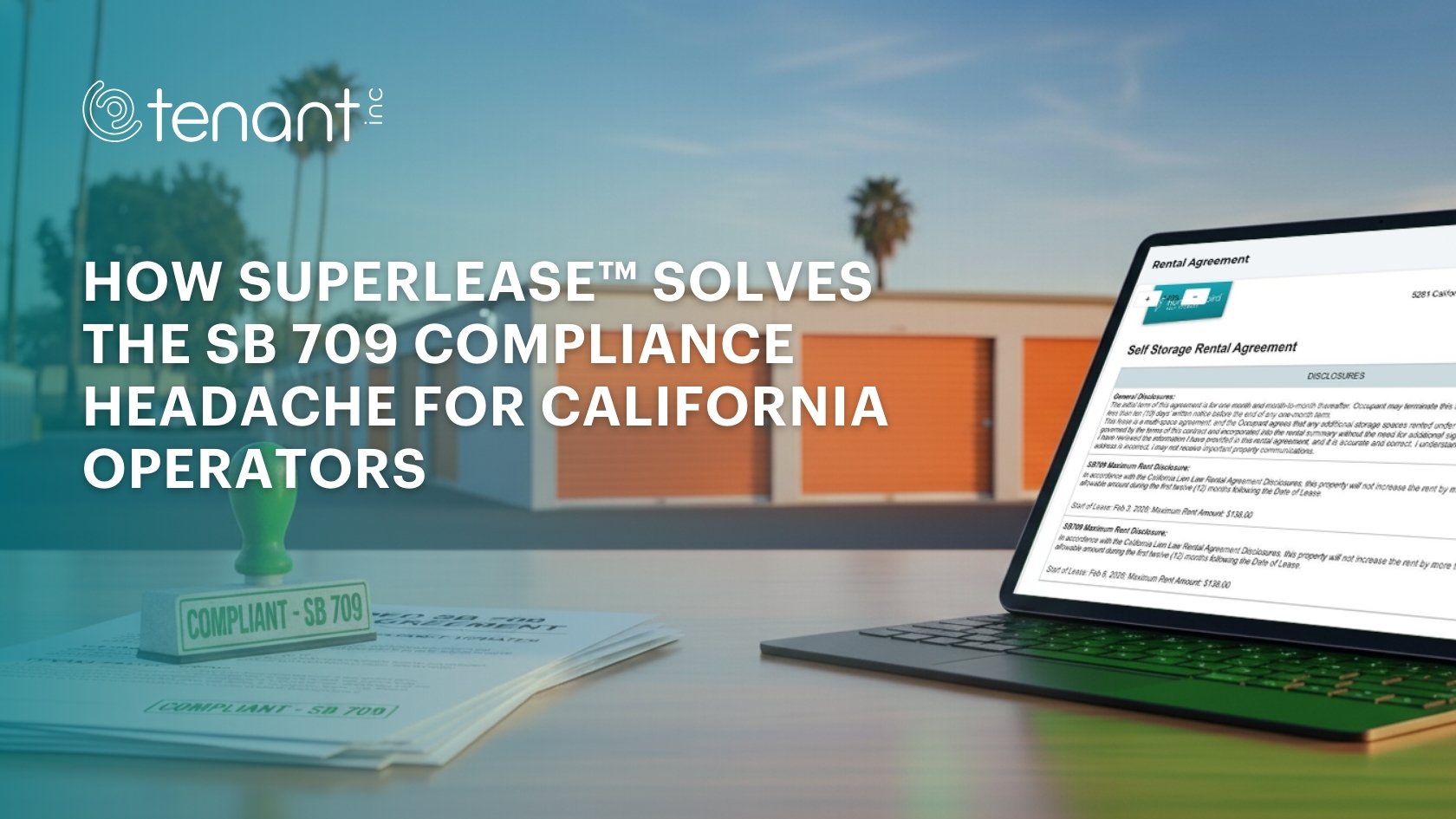
If you operate a self-storage facility in California, January 1, 2026 marked a seismic shift in your daily operations. The enactment of Senate Bill 709 (SB 709), specifically the addition of Section 21715.2 to the Business and Professions Code, did not just add a few lines of fine print to your rental agreements. It fundamentally altered the mechanics of how you lease units, disclose prices, and manage tenant relationships.
For decades, the self-storage lease was a static document, often a PDF or a physical piece of paper stored in a filing cabinet. It was signed once and rarely revisited until a move-out or a legal dispute. In the current regulatory environment, a static lease is a liability. SB 709 requires rental agreements to be dynamic, transparent, and rigorously compliant with specific formatting standards that are nearly impossible to manage manually at scale.
This article dives deep into the specific requirements of SB 709, the operational risks of non-compliance, and how Tenant Inc.’s SuperLease™ + OpenClick™ solution has been engineered to turn this regulatory burden into an automated, seamless part of your workflow.
Part 1: Deconstructing SB 709 – What is Actually Required?
To understand the solution, we must first confront the problem. SB 709 was introduced in response to consumer protection concerns around bait-and-switch pricing, where tenants move in at a low promotional rate and face significant rent increases shortly after.
The legislation places three primary burdens on operators, as outlined in the enacted text:
Transparency in Pricing: Operators must explicitly disclose whether a rental fee is discounted or promotional, the duration of that promotion, and the maximum rental fee that could be charged during the first 12 months following the date of the agreement.
Strict Rent Cap Formulas: The bill limits rent increases within the first 12 months. The formula is specific and non-negotiable: increases cannot exceed 5% plus the percentage change in the Consumer Price Index (CPI), or 10% total—whichever is lower.
The "First Page" Rule & Formatting: Perhaps the most operationally annoying requirement is the formatting. These disclosures cannot be buried in an addendum on page 4. They must appear on the first page of the rental agreement. Furthermore, the text must be in a "larger type" than the surrounding text, or in a "contrasting type, font, or color" to ensure it captures the consumer's attention.
The Operational Nightmare of Manual Compliance
Consider the workflow of a typical operator with 500 units in Los Angeles. You likely have different street rates, different promotional offers (e.g., "First Month Free" vs. "50% Off for 3 Months"), and leases executed at different times of the year when the applicable CPI data might vary.
If you are using a legacy management system or static PDF leases, compliance requires a manual checklist for every single move-in. This manual process is a breeding ground for human error. A single mistake—a font size too small, or another formatting error—can render a lease non-compliant. In a litigious state like California, this exposes your facility to potential class-action lawsuits or regulatory fines. In an industry operating on thin margins and high efficiency, you cannot afford to have site managers acting as paralegals.
Part 2: Enter SuperLease™ – The First AI-Enabled Lease Management Solution for Self Storage
Tenant Inc. anticipated this shift. We recognized that the industry needed to move away from "digitized paper" (PDFs) toward "data-driven agreements." This philosophy is the core of SuperLease™.
What is SuperLease™?
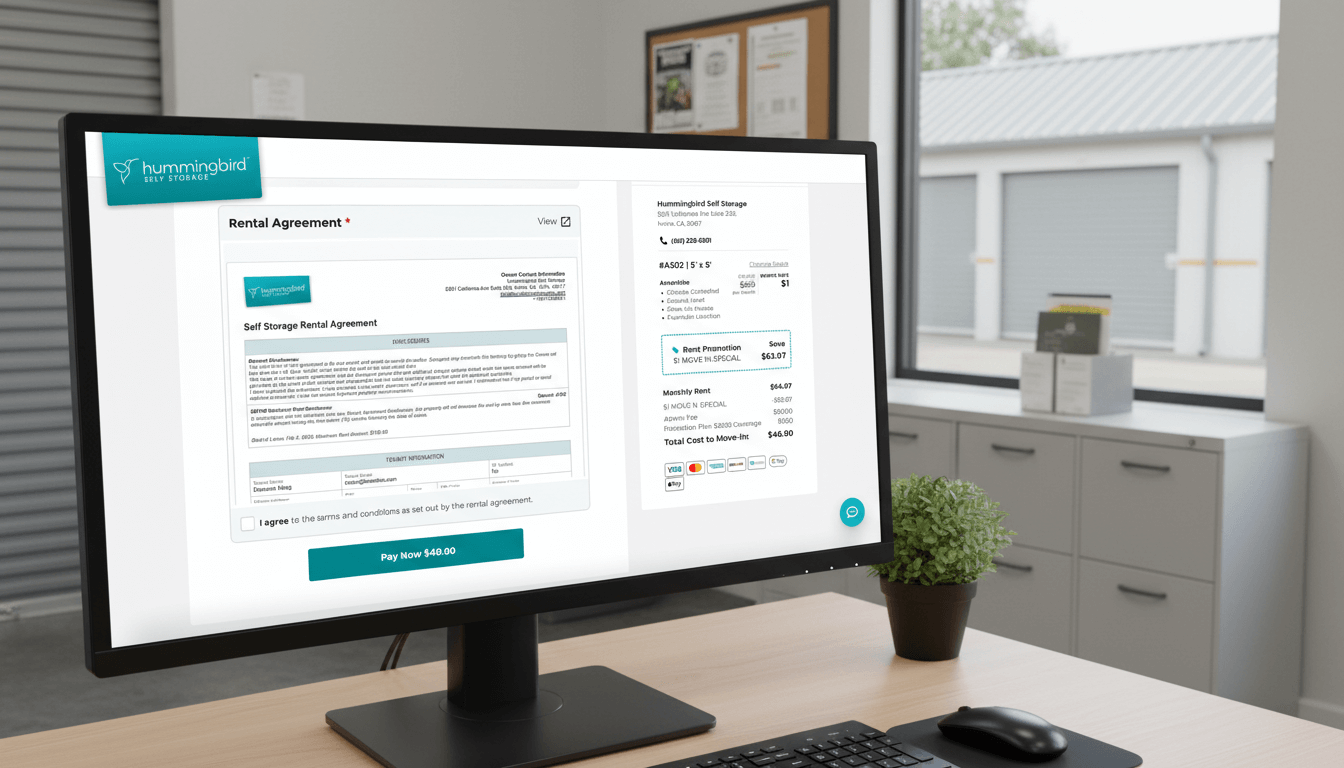
SuperLease is not a document in the traditional sense; it is a structured, digital-first agreement system. Unlike a static template that must be manually updated, SuperLease is connected directly to the Hummingbird Property Management Software (PMS). It pulls real-time data regarding the tenant, the specific unit, the active promotion, and the current regulatory parameters to generate a lease that is custom-built for that specific transaction at the moment of execution.
How SuperLease Automates SB 709 Compliance
SuperLease simplifies SB 709 compliance by automating the key disclosure requirements, ensuring your rental agreements are always up-to-date and legally sound without extra effort from your team. Here's how it works:
Automatic Surfacing of Disclosures: SuperLease intelligently places all required disclosures on the first page of the rental agreement, making them prominent and easy to find. This eliminates the need for manual placement or reformatting, reducing errors and ensuring tenants see critical information upfront.
Highlighting Key Details: The system automatically highlights essential elements like the initial term, promotion details, and renewal term, using clear, compliant formatting to meet SB 709 standards. This not only aids tenant understanding but also protects operators from potential disputes.
Version Control Elimination: Say goodbye to editing lease templates for each change. SuperLease handles updates dynamically, minimizing maintenance and letting property teams focus on operations rather than paperwork.
This enhancement helps property teams stay compliant effortlessly, without additional setup or ongoing maintenance. By automating these processes, SuperLease not only saves time but also minimizes risk, allowing you to prioritize growth and tenant satisfaction in a regulated environment.
Part 3: OpenClick™ Signing – Speed Meets Security
SB 709 compliance addresses what is signed... OpenClick addresses how it is signed.
Legacy e-signature solutions often mimic the paper process—presenting a PDF on a screen and asking the tenant to "scribble" a signature with their finger. While familiar, this process adds friction. It slows down the move-in, especially on mobile devices.
.jpeg)
The OpenClick™ Advantage
Tenant Inc. has introduced OpenClick™ signing to Mariposa, replacing the multi-step "scribble" with a single, legally binding on-screen confirmation.
Frictionless Experience: The tenant reads the scrollable agreement (with the SB 709 disclosures prominently displayed) and clicks a single "I Agree" button. This reduces the time-to-rent significantly, which is critical for converting mobile traffic where abandonment rates are high.
Cryptographic Evidence: While it feels simple to the user, the backend is robust. Each Clickwrap execution generates a verifiable cryptographic signature. The system captures the timestamp, the IP address, the device data, and the exact version of the document presented.
Auditable Record: In the event of a dispute, you don't just have a PDF with a squiggle on it. You have a data-rich audit trail proving exactly when and where the tenant accepted the terms.
Part 4: The Broader Context – Why Automation is the Only Way Forward
The introduction of SB 709 is likely just the beginning. As the self-storage industry matures and consolidates, it attracts more scrutiny from regulators. We are seeing similar conversations regarding late fees, lien auction timelines, and insurance sales in other jurisdictions.
Operators who rely on manual intervention to handle compliance are fighting a losing battle. The administrative overhead will eventually erode profitability.
Scalability: If you plan to grow from one facility to ten, or ten to fifty, you cannot rely on site managers to be your compliance officers. You need a system that enforces compliance programmatically.
Risk Mitigation: Investors and lenders are increasingly looking at operational risk. A facility running on a compliant, automated platform like Hummingbird represents a lower risk profile than one relying on manual lease audits.

Part 5: Implementing SuperLease™ in Your Workflow
Transitioning to SuperLease is seamless for Hummingbird users. Because the compliance tools are embedded into the revenue and promotion workflows, the setup involves configuring your facility’s specific parameters once.
Steps to Compliance:
Configure Revenue Rules: Set your street rates and promotional triggers in the Hummingbird Rate Management Center.
Activate SB 709 Tools: For California locations, enable SB 709 compliance automation with a few, quick clicks.
Deploy: The next lease generated for a move-in will automatically feature the required first-page disclosures and update as the tenant relationship changes.
Conclusion: Turning Compliance into Confidence
Regulatory changes like SB 709 are often viewed as a headache—a tax on doing business. But they also present an opportunity for self-storage operators to modernize their operations. By adopting SuperLease™ and OpenClick™, you aren't just checking a box to satisfy the state of California. You are upgrading your customer experience, reducing move-in friction, and insulating your business from risk.
In 2026, the most successful operators won't be the ones with the best spreadsheets... they will be the ones who let their software handle the complexity, freeing them to focus on growth, customer service, and expansion.
Ready to automate compliance across your portfolio? Learn more about enabling SuperLease™ in Hummingbird today.

.png?width=352&name=The%20Self-Storage%20PMS%20Comparison%20Guide%20What%20Operators%20Actually%20Need%20in%202026%20Featured%20Image%20(1).png)