
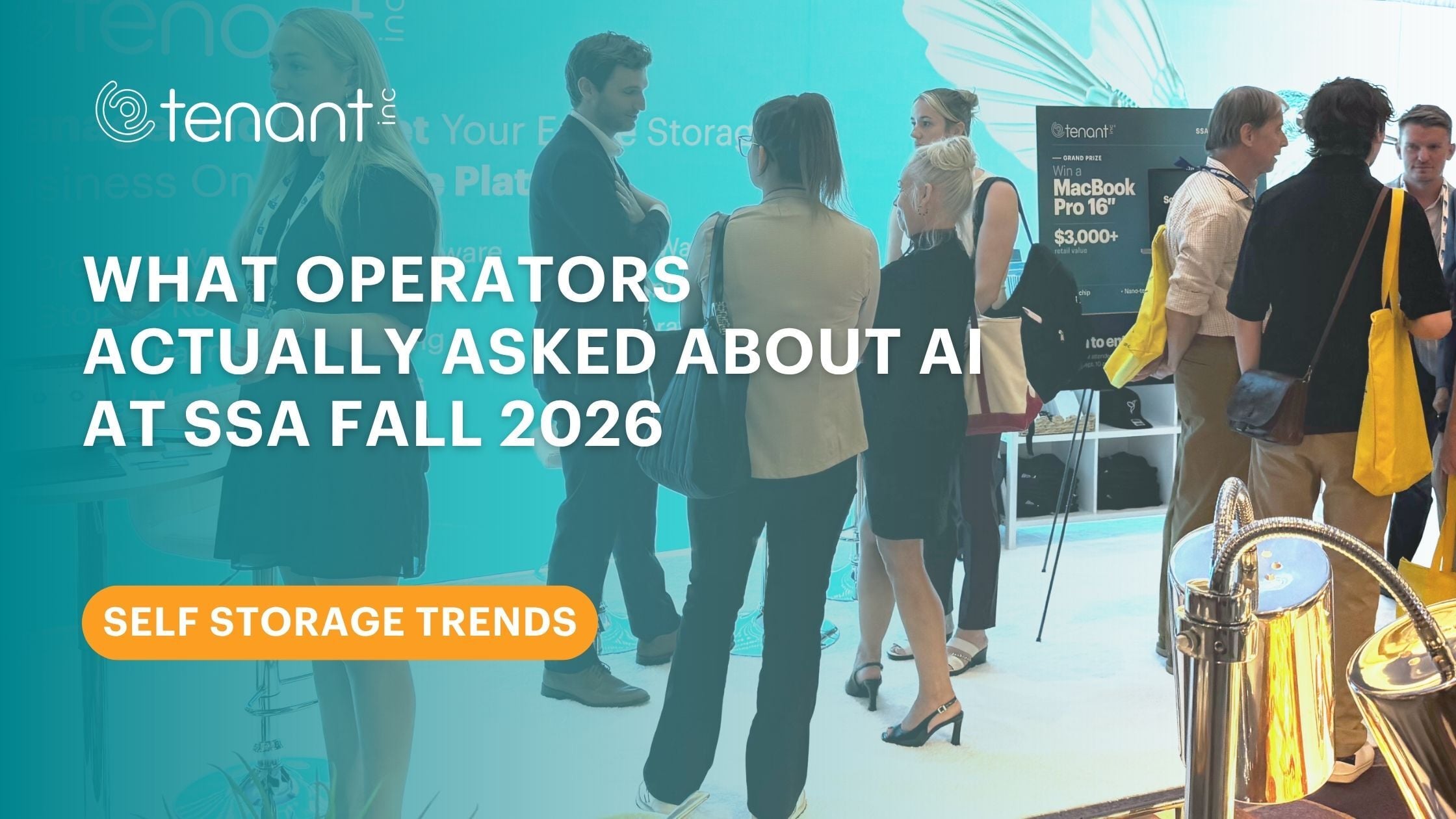
Ask anybody that made the trip to Las Vegas and walked the trade show floor at SSA Fall, and you can count the booths that did not mention artificial intelligence on one hand. Marketing vendors, access control companies, call centers, management platforms. The two letters were on everything from the banners to the banded merch.
That is not a criticism of the technology. Some of what was on that floor works, and works well. The problem is that the label has become free to use, which means the burden of figuring out what is real has shifted entirely to the operator walking the aisle.
We spent four days at SSA Fall talking to operators about exactly that. In a roundtable session, we asked everyone at the table to write down five questions they wished AI could answer for their business. Real ones, from their own operation, including the ones they were convinced no software could handle.
The questions were better than the marketing. This post is about what operators asked, what the answers actually are today, and how to evaluate any AI claim you hear between now and the next show.
The questions sorted into three buckets
Across the sessions, almost every question landed in one of three categories. That sorting turned out to be more useful than any individual answer, because each category has a genuinely different honest answer about where the technology stands.
Operational questions were the tenant-facing ones. What is my gate code. Can I move to a bigger space. What happens if I pay on the twelfth. Why is there a lock on my door.
Financial questions were the ones the operator asks, not the tenant. Which facilities are underperforming on street rate. What did delinquency recover last quarter. Where is protection attachment weakest.
Marketing questions were about where the money goes. Which channel produced that rental. Was that call a new customer or an existing tenant. Is the ad spend working.
The instinct is to treat these as one problem with one answer. They are not. The operational bucket is largely solved. The financial bucket is solved conditionally. The marketing bucket has a problem underneath it that AI does not fix.

Operational questions are mostly answered today
This is the bucket where the technology has genuinely arrived, and where the gap between demo and deployment has closed.
An AI agent that reads live operating data can retrieve a gate code, quote a current rate, check real availability, take a payment, and complete a rental. Not in a controlled demo. On a Sunday night, from a tenant standing at a gate, with no staff involved.
The qualifier in that sentence is doing the work: reads live operating data. An agent working from a nightly export or a static knowledge base is a very confident answering machine. It will tell a renter a space is available that was rented four hours ago. The difference between an AI that resolves an interaction and one that creates a cleanup task for your manager is entirely a question of what data it can see at the moment it is asked.
The exceptions are the high-stakes decisions, and they should stay exceptions. Lock cuts. Auction decisions. A tenant in genuine financial distress. Those require human sign-off, and any vendor suggesting otherwise is selling liability rather than efficiency. The operators at these tables understood that instinctively. Several of them wrote it down as a question specifically to see whether we would claim otherwise.
Financial questions depend on governance, not on the model
The financial bucket produced the most interesting conversations, because this is where operators expect the answer to be a technology problem and it usually is not.
AI is now good at answering questions directly from operational data instead of requiring someone to build a report first. Which stores are below market. What the delinquency curve looks like this quarter compared to last. Where protection attachment is weakest and by how much.
The constraint is not the model. It is whether the definitions, rules, and policies that make those numbers meaningful actually live in a system.
If your late fee logic lives in a regional manager's head, no model can apply it. If two facilities calculate economic occupancy differently, an AI asked to compare them will produce a confident number that means nothing. Bad data creates more bad data, and it compounds quietly, because the output looks authoritative either way.
This is the least exciting finding from four days of conversations and probably the most important one. The operators who will get the most out of AI over the next two years are the ones who put their governance in order first. That work is unglamorous and it does not require buying anything.

Marketing questions have a measurement problem underneath them
The marketing bucket is where the most money gets wasted, and it is the bucket where AI is least likely to help without other work happening first.
The questions themselves are reasonable. Which channel produced this rental. Was that phone call a new prospect or an existing tenant with a billing question. Did that campaign pay for itself.
The problem is that AI can count anything you point it at. What it cannot do is decide what should have been counted. If a conversion is defined as a form fill, an AI will optimize enthusiastically toward form fills, including the ones from tenants who already rent from you. If phone calls are not distinguished by caller type, the attribution will be confidently wrong in a way that is expensive and hard to see.
Fixing what a conversion means is a prerequisite, not a follow-up. Operators who skip that step end up with faster answers to the wrong question.
The questions worth asking any vendor
Several operators asked a version of the same meta-question: how do I tell the difference between a real capability and a good demo? The answer is a short list of questions that any serious vendor can answer without hesitating.
What live data does this read, and what does it not see? This is the single most clarifying question on the list. It separates agents that can complete a transaction from agents that can only describe one.
Which decisions does it make on its own, and which require sign-off? A vendor with a clear answer here has deployed this somewhere real. A vendor who has not thought about it has not.
How does it learn our specific policies? Per facility, not a generic script. Rates change, rules differ by state, and an agent that cannot absorb those differences will be wrong in ways that create liability.
How will we measure it? Not interactions or engagement. First-call resolution. Rentals completed. Revenue converted. If a vendor cannot name the number that should move, they have not deployed this anywhere that counted.
When the next tool comes out, how do we connect it? New AI companies launch every month and some of them will build something genuinely useful for storage. The question is whether your platform lets you connect it through an open API in weeks, or whether you wait for your software vendor to build their own version on their own timeline. That is the difference between owning your technology decisions and renting them.

Where this goes next
One theme ran through the week without anyone naming it directly.
Voice and chat answering the phone is becoming table stakes. Within a year, most vendors on that floor will have a version of it, and the competitive advantage of having an AI answer your phone will be roughly the same as the competitive advantage of having a website.
What comes after that is agents working inside the operation rather than at the front of it. Watching delinquency timelines and flagging what needs attention. Preparing auction documentation. Following up on marketing leads that went cold. Reading the financials and surfacing the thing nobody asked about.
That shift will favor operators whose data is already in order and whose platform already connects to things. Both of those are decisions being made now, quietly, by operators who are not waiting for the technology to be finished before they prepare for it.
The questions on those cards were sharper than anything printed on the banners above them. That is usually a good sign about where an industry is heading.
.png)
%202.png?width=352&name=Streamlining%20Tenant%20Communication%20with%20Automation%20(3)%202.png)
.png?width=352&name=The%20Numbers%20Dont%20Lie%20A%20Look%20at%20the%20Real-World%20ROI%20of%20Modern%20Self%20Storage%20Software%20Featured%20Img%20(1).png)