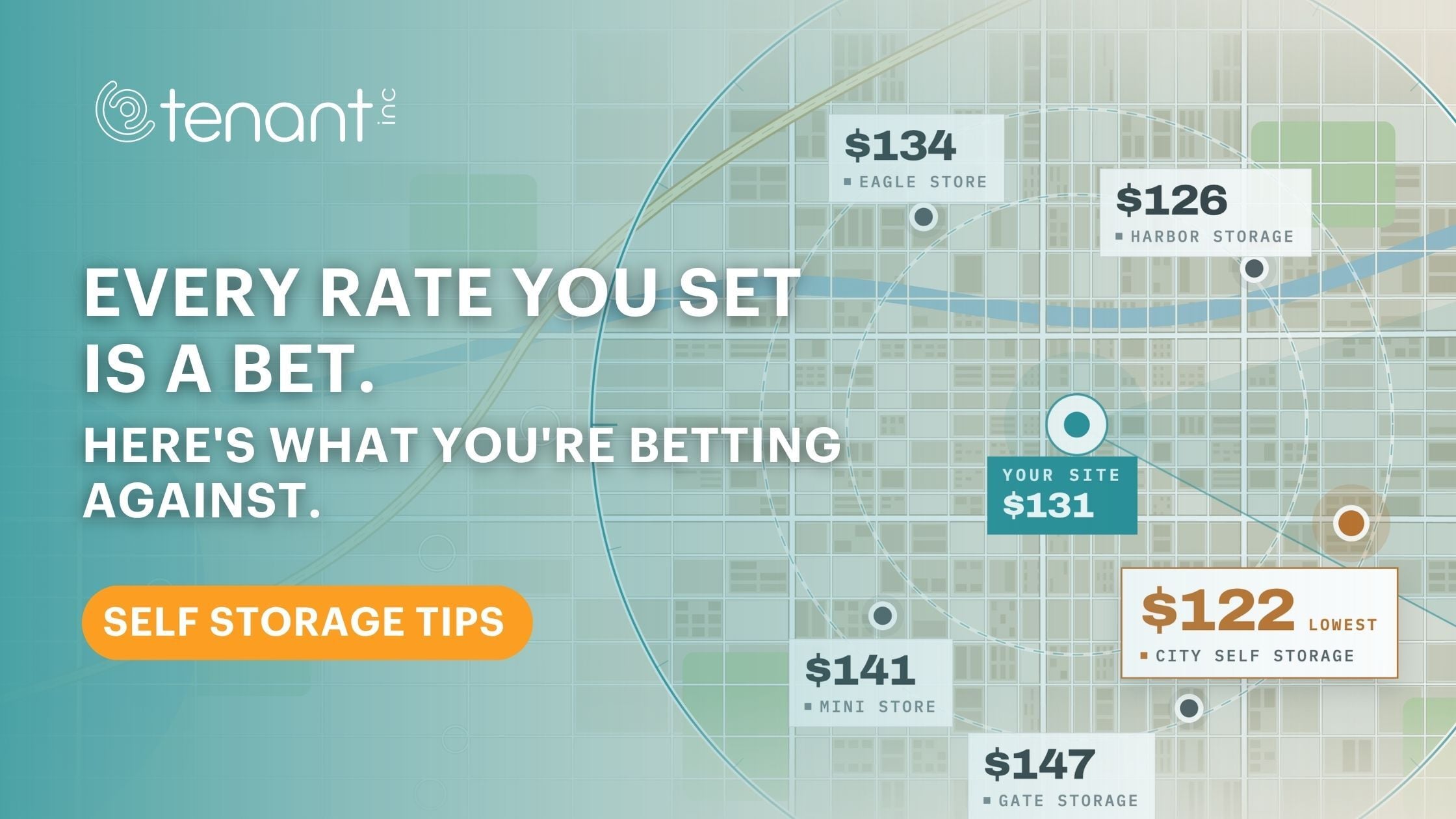
There is a moment every month in every self-storage operation where somebody decides what a 10x10 climate space is worth. Maybe it is a revenue management system proposing a number. Maybe it is a regional manager who has run that market for nine years. Maybe it is an owner who looks at occupancy, thinks about it for a minute, and moves the rate four dollars.
Whatever the process, that decision is a bet on what the market will bear. And the quality of the bet depends almost entirely on what the person making it can see at the moment they make it.
This post is about what operators can actually see when they set rates, why the answer is usually less than they think, and what changes when the market picture lives in the same place as the decision.
The street survey was never the problem
The industry's instinct is to treat manual market research as the villain. Somebody drives the market, calls four competitors, writes down rates, and types them into a spreadsheet. It is slow, it goes stale, and it only captures what is posted publicly on a given Tuesday.
All of that is true, and most operators stopped doing it that way years ago. Rate feeds, subscriptions, and aggregators solved the collection problem. If you want to know what the facility two miles away charges, that information is available.
The harder problem is where it lives.
Market data usually arrives in one system and rate decisions get made in another. So the information has to be carried, by a person, from a report or a dashboard or an email into the screen where the rate actually changes. And carrying costs something. It costs the time to go get it, which means it happens on a schedule rather than at the moment of decision. It costs accuracy, because what gets carried is a summary rather than the whole picture. And it costs consistency, because the manager who does this well does it every month and the one who is busy does it sometimes.
The result is not that operators price blind. It is that they price with a market picture that is a few weeks old, a few facilities short, and summarized by whoever assembled it.

What a recommended rate does not tell you
The obvious response is that this is what revenue management software is for, and for a lot of operators it is. A pricing engine ingests demand signals, occupancy, seasonality, and competitive feeds, runs it through a model, and proposes a number. Those systems work. Operators running them are not guessing.
But a recommended rate and a view of the market are two different things, and they are useful in different moments.
The recommendation answers what should I charge. It is a synthesis, and its value is that you do not have to do the synthesizing. The market view answers what is everyone around me actually doing, and its value is that you can see the inputs rather than the conclusion.
Most of the time the recommendation is enough. The moments it is not enough are the ones that matter most: a competitor drops rates and you want to know whether it is a promotion or a trend. A new facility opens in your radius and you need to understand its position before you react. An owner asks why your 10x15 is priced where it is and the answer needs to be more than the software said so.
Those conversations require the underlying picture, not the output.
Where the data has to be
If the friction is that market information lives somewhere other than the decision, the fix is straightforward to describe and harder to build: put it in the same place.
Through Tenant Inc.'s partnership with TractIQ, competitor street rates now appear inside Hummingbird. What competing facilities charge for the same space type, at a radius the operator chooses of 3, 5, or 10 miles, refreshed monthly.
Three places specifically, chosen because they are where rate decisions get made or explained:
In Rate Management. When a rate gets set for a space type, the market rate for that same space type is there, as a direct rate or as dollars per square foot.
In Rent Roll. In-place rates benchmarked against the average street rate inside the selected radius, so above or below market reads at a glance rather than requiring a comparison.
In every management report. Competitor context travels with the operational numbers, which means the monthly owner review starts with the market already in the room.
None of this decides anything. If an operator runs a pricing engine, that engine still sets the rate. This is the picture underneath it, visible in the place where the decision happens.
What this is worth
The honest answer is that it depends on how far off your current picture is, and most operators do not know.
That is not a criticism. It is a structural property of the problem: if your market view is assembled monthly from a summary, you cannot easily audit how much it missed, because the thing you would audit it against is the same summary.
What changes with the data in place is not that operators suddenly price correctly. It is that the gap between what the market is doing and what the person setting rates can see gets smaller, and it gets smaller for every property rather than for the ones whose manager is diligent about the monthly survey.
For a single facility, that might be worth a few dollars a month on a handful of space types. For a portfolio, it compounds across every rate decision at every property, every month, including the properties nobody has had time to look at closely.
The questions worth asking
Whatever platform an operator runs, the useful question is not whether they have access to market data. Almost everyone does now.
The question is how many steps sit between that data and the person setting the rate, and how often those steps actually get taken.
If the answer is a report somebody pulls monthly, the market picture in your rate decisions is a monthly picture. If the answer is a subscription somebody logs into when they remember, it is an occasional picture. Neither is wrong, and both are worth knowing about honestly, because the bet gets placed either way.
.png)