
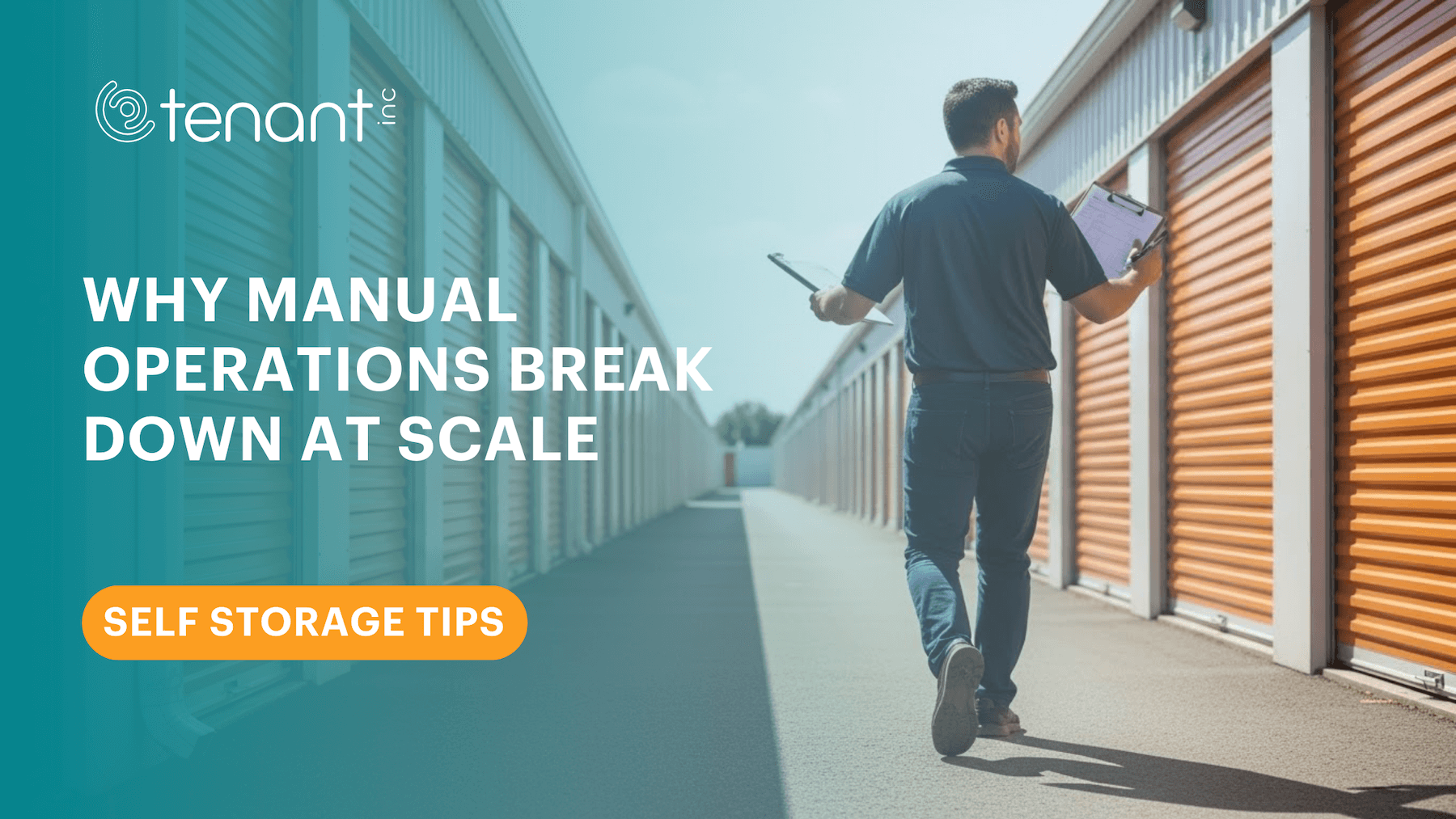
Manual operations are often defended as flexible, personal, and proven. For small self storage portfolios, that defense is not wrong. Early growth is frequently powered by hands-on oversight, local knowledge, and experienced managers making judgment calls in real time. At limited scale, this approach can work remarkably well.
The problem is not that manual operations fail immediately. The problem is that they fail quietly as scale increases.
By the time breakdowns become visible through missed revenue, compliance exposure, or operational fatigue, the root cause is often deeply embedded in day-to-day workflows. Growth does not stall because demand disappears. It stalls because manual systems cannot keep up.
The Illusion of Control in Manual Processes
One of the strongest arguments for manual operations is control. Operators feel closer to decisions when people are directly involved in execution. Adjustments can be made quickly, exceptions can be handled intuitively, and experience fills gaps that systems might miss.
At scale, this sense of control becomes fragmented.
As portfolios grow, decision-making spreads across multiple locations, teams, and interpretations of “how things should be done.” Pricing guidelines are applied differently. Lease language evolves through informal edits. Communication standards vary by manager. What once felt flexible becomes inconsistent.
Control shifts from systems to individuals, and consistency begins to erode.

Inconsistency Is the First Failure Point
The first way manual operations break down is through inconsistency. This rarely happens all at once. It appears gradually as sites adapt processes to local preferences or legacy habits.
Pricing strategies may be defined centrally, but execution varies. Promotional rules are interpreted differently. Lease disclosures drift as documents are copied and modified. Tenant communications lose uniform tone and structure.
Inconsistency creates two problems simultaneously. Customers experience uneven service, and operators accumulate regulatory exposure. Neither issue is immediately obvious, but both grow with scale.
Latency Turns Missed Time into Missed Revenue
The second failure point is latency. Manual steps introduce delays that compound across portfolios.
Leads wait longer for responses. Rate changes take days instead of minutes. Lease execution slows as documents are reviewed, corrected, and reissued. Individually, these delays seem manageable. Collectively, they translate into lost conversions and reduced revenue velocity.
At scale, speed matters. Markets change quickly, and pricing opportunities are time-sensitive. Manual workflows simply cannot respond with the consistency or speed that modern operations require.

Error Multiplication at Portfolio Scale
The third failure point is error multiplication. Every manual process carries some risk of error. At small volumes, those errors are usually caught and corrected quickly.
At scale, errors replicate.
A pricing mistake applied manually can affect dozens of units before it is noticed. An outdated lease clause can be reused across multiple locations. A misconfigured promotion can propagate across an entire region. What was once a minor issue becomes a systemic one.
This is not a people problem. It is a scale problem.
Why Systems Scale and People Should Not Have To
People excel at judgment, problem-solving, and exception handling. Systems excel at repetition, enforcement, and consistency. Successful scaling requires using each where they are strongest.
Manual operations ask people to do what systems do better. As scale increases, this mismatch becomes unsustainable. Teams spend more time managing routine execution and less time overseeing performance or addressing edge cases.
Automation shifts routine work to systems, allowing people to focus on higher-value activities. This is not about reducing headcount. It is about reducing operational strain as portfolios grow.
The Role of Automation in Sustainable Growth
Automation addresses the exact failure points that manual operations create.
By enforcing standardized workflows, automation eliminates inconsistency. By executing rules instantly, it removes latency. By applying logic uniformly, it reduces error replication.
Most importantly, automation creates visibility. Operators gain clearer insight into performance across locations without relying on manual reporting or reconciliation. This visibility enables better decision-making at scale.
Control Through Structure, Not Intervention
A common misconception is that automation reduces control. In reality, it redefines it.
Instead of relying on intervention after issues arise, operators embed control into systems upfront. Rules are defined once and applied consistently. Exceptions are surfaced clearly instead of hidden within manual processes.
This shift allows operators to scale with confidence rather than constant oversight.

The Cost of Waiting Too Long
Operators who delay automation often do so because manual processes still appear to be working. By the time breakdowns are obvious, the cost of change is higher and the urgency is greater.
Scaling successfully requires anticipating these limits before they are reached.
Scaling Without Increasing Risk
Manual operations are not a failure. They are a phase. The mistake is treating them as a long-term strategy.
At scale, sustainable growth depends on systems that can execute reliably, consistently, and quickly. Automation provides that foundation.
Operators who make this transition early gain leverage. Those who wait find themselves constrained not by the market, but by their own operations.
Curious how much time (and money) a modern self-storage management platform can save your team? Schedule a demo today to see the tools in action:

.png?width=352&name=Tenant%20Inc.%20Launches%20Featherlink%20Connector%20Featured%20Img%20(1).png)

.png?width=352&name=New%20Feature%20Update%20December%202025%20Featured%20Img%20%20(1).png)