The hardest part of acquiring a self-storage tenant isn't getting them to your website. It isn't getting them to select a unit. It isn't even getting them to start checkout.
It's getting them across the finish line.
Somewhere between "I want this unit" and "lease signed," a significant percentage of renters abandon the process. They close the tab. They get distracted. They hit a step that creates enough friction to break their momentum. And because the dropout happens inside a checkout flow rather than at the top of the funnel, most operators either don't see it or underestimate what it's costing them.
This post is about what abandonment actually costs, why it happens, and what the difference is between a checkout flow that captures tenants at peak intent and one that lets them walk away.
The Math Most Operators Haven't Run
Before getting into causes and solutions, it's worth sitting with the revenue math — because the numbers change how operators think about checkout friction.
Take a facility with 500 monthly website visitors. A 6% conversion rate — reasonable for a well-trafficked self-storage site — means 30 rentals per month. Average monthly revenue per unit of $140, average length of stay of 18 months. Each converted tenant is worth approximately $2,520 in lifetime revenue.
Now consider what a 2-point improvement in conversion — from 6% to 8% — means. Ten additional rentals per month. At $2,520 per tenant, that's $25,200 in additional lifetime revenue generated every month from the same traffic. Annually, over $300,000.
That is not a marketing problem. It is a checkout problem. And unlike traffic acquisition, which requires ongoing spend to maintain, fixing checkout conversion is a one-time infrastructure change with a compounding return.
The operators who have moved to a frictionless checkout flow — one designed to capture commitment at peak intent rather than present administrative steps at the end of an already-made decision — have seen checkout abandonment drop 20-30% in deployed portfolios. That number doesn't come from a better marketing campaign. It comes from building a checkout flow that doesn't give tenants a reason to leave.
Why Tenants Abandon Self-Storage Checkout
Abandonment isn't random. It happens at predictable points in the rental flow, for predictable reasons. Understanding those reasons is the first step to eliminating them.
The lease presented as a final hurdle. In many self-storage checkout flows, the lease appears at the end — after unit selection, after pricing, after payment details. By the time the tenant reaches it, they've already done the work of deciding. Presenting a document to review and sign at that point doesn't feel like the last step. It feels like a new task. For tenants on mobile, it's often the point where they give up entirely.
E-signature workflows that happen outside checkout. Sending a lease to an email address for signature outside the checkout flow introduces a gap between intent and action. The tenant has to leave the session, open their email, open the document, sign it, and return. Each step is a drop-off point. Many never complete the loop.
ID verification and compliance steps that feel like friction. State-specific requirements — ID verification, secondary contact capture, disclosure acknowledgments — are legally necessary. But when they're presented as a series of unexpected steps after a tenant believes they've already completed checkout, they feel like obstacles rather than requirements. The reaction is often abandonment.
Checkout that isn't built for mobile. More than half of self-storage research and an increasing share of rentals happen on mobile devices. A checkout flow optimized for desktop that's been adapted for mobile — rather than built mobile-first — creates friction at every step. Form fields that require zooming in. Signature workflows that don't function correctly on touchscreens. Lease documents that aren't readable without horizontal scrolling.
Each of these friction points represents a decision point where a tenant who had already chosen your facility opts out. None of them are unavoidable. All of them are design choices.

What a Checkout Flow Built for Conversion Actually Does
The difference between a checkout flow that captures tenants and one that loses them isn't a feature. It's an architecture — the sequence and structure of the steps between unit selection and signed lease.
A conversion-first checkout is built around one principle: capture commitment at the moment of highest intent, and remove every step that doesn't have to happen before that moment.
In practice that means:
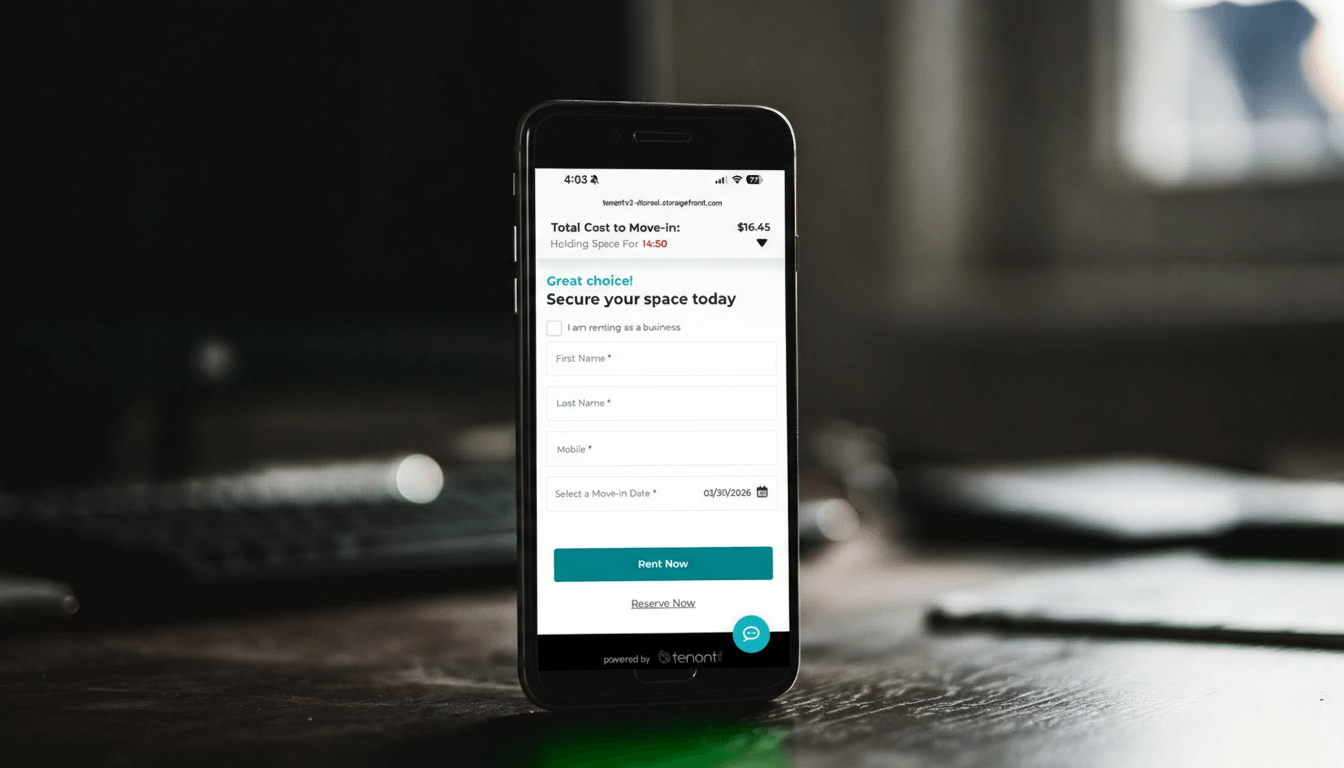
Payment captured before the lease, not after. When a tenant provides payment details at the point of unit selection — before the lease is presented — they've made a financial commitment. The lease becomes a confirmation of a decision already made rather than a gate in front of it. Abandonment at the lease step drops significantly.
Lease execution inside the checkout flow, not alongside it. The lease isn't emailed. It isn't opened in a separate window. It's presented, reviewed, and signed within the same flow the tenant is already in — on the same screen, with a single enforceable action. No session breaks. No return trips from email.
Compliance enforced as part of the flow, not appended to it. ID verification, secondary contact capture, mailing address confirmation, and state-specific disclosure acknowledgments are built into the checkout sequence as required steps — not presented as a surprise after the tenant believes they've finished. When compliance is expected, it doesn't feel like friction.
Protection and add-ons surfaced mid-flow. Presenting insurance, protection coverage, and upgrade options at the point of unit selection — when the tenant is engaged and deciding — captures ancillary revenue at peak intent. Presenting them after checkout as a follow-up email or move-in conversation captures a fraction of what's available at the moment of decision.
Mobile-first design throughout. Not a responsive version of a desktop flow. A checkout experience built from the ground up for the way most tenants are actually renting — on a phone, in a few minutes, between other things.
The result of getting this architecture right is a checkout flow that tenants complete rather than abandon. Operators deploying this approach see abandonment drop 20-30% — not because they've made the lease less rigorous or the compliance less thorough, but because they've removed the friction that had nothing to do with either.
The Living Lease: What Happens After Checkout
Most self-storage operators focus their conversion thinking on the checkout moment — getting from traffic to signed lease. What happens after that moment matters too, and it's where most lease implementations fall short in ways that create downstream problems.
A lease signed at move-in reflects the relationship on move-in day. Over the course of a tenancy — which averaged 18.5 months nationally in 2025 — that relationship changes. The tenant enrolls in autopay. They add protection coverage. They update their mailing address. They add a secondary contact.
In most systems, none of those changes are reflected in the lease. The original document sits unchanged while the actual relationship evolves around it. The result is a lease that no longer reflects reality — a document management problem that creates audit exposure, dispute vulnerability, and operational noise when something goes wrong.
A lease engine that updates automatically when the tenant relationship changes means the document always reflects what was actually agreed to and when. There's no version drift. No manual document management. No liability from a lease that no longer matches the tenant's actual situation. The lease is a living record of the relationship, not a snapshot of move-in day.
This isn't a minor operational detail. In markets where regulatory scrutiny is increasing — California's SB 709 requirements, rent control provisions, and disclosure obligations are a leading indicator of where other states are heading — having a lease that accurately reflects the current state of every tenant relationship is a compliance asset, not just an operational convenience.
What the Numbers Look Like at Scale
One operator in the Tenant Inc. portfolio posted these same-store results in January 2026 versus January 2025 — historically one of the softest months in self-storage:
-
Occupied Revenue: +5.4%
-
Occupancy: +1.8%
-
Occupied Rent: +3.5%
Across a broader same-store portfolio comparison for Q3 2025 versus Q3 2024:
-
Occupied Revenue: +4.7%
-
Occupied Rent: +2.3%
And for a single subject store over two years:
-
Total Income Growth: +79%
-
Rate per Square Foot Growth: +71%
-
Occupancy: +5 points, now above 90%
These results happened during a period when the broader self-storage market was flat to declining — move-in rates down more than 10% year-over-year, national occupancy stabilized but not growing, housing market soft.
The gap between those market conditions and these operator results doesn't come from one thing. But conversion — capturing the tenants who were already interested rather than losing them in checkout — is part of the story. Revenue you capture from tenants who found you and started the process is the highest-margin acquisition available. It costs nothing in additional marketing spend. It requires only a checkout flow that doesn't get in its own way.
.png)
The Actual Intelligence Angle
Checkout abandonment is one of the clearest examples of the difference between artificial and actual intelligence in self-storage software.
An AI-powered checkout that presents a lease at the wrong moment, sends it to an email address, and waits for a tenant to return from a separate workflow isn't intelligent — regardless of what the vendor calls it. The intelligence is in the architecture: the sequence of steps, the placement of commitment points, the enforcement of compliance requirements, and the design of the mobile experience.
Actual Intelligence in checkout means a flow that captures tenants because it's built around how tenants actually make decisions — not how software vendors prefer to structure their demo.
Artificial Intelligence is the hype. Actual Intelligence is the checkout flow a tenant completes.
Tenant Inc.'s SuperLease™ is the lease execution engine built into Mariposa, Tenant Inc.'s online rental platform. Operators deploying SuperLease have seen checkout abandonment drop 20-30% in deployed portfolios.