.png)
AI chat is no longer a differentiator in self-storage. It's an expectation. Prospects arriving at a self-storage website in 2026 increasingly expect to find a chat window — something that can answer a question, surface availability, and help them figure out what they need without picking up the phone.
Most facilities have met that expectation. A chat widget is live. Questions get answered. The box is checked.
What most facilities haven't done is take the next step: building a chat experience that doesn't just answer questions but actually closes rentals. And that gap — between chat that responds and chat that converts — is where a meaningful amount of revenue is quietly being lost every day.
This post is about what that gap looks like, why it exists, and what changes when you close it.
The Difference Between Answering and Converting
Start with a simple scenario. A renter lands on a self-storage website at 9pm on a Sunday. They need a 10x10 climate-controlled unit. They open the chat window and ask if any are available.
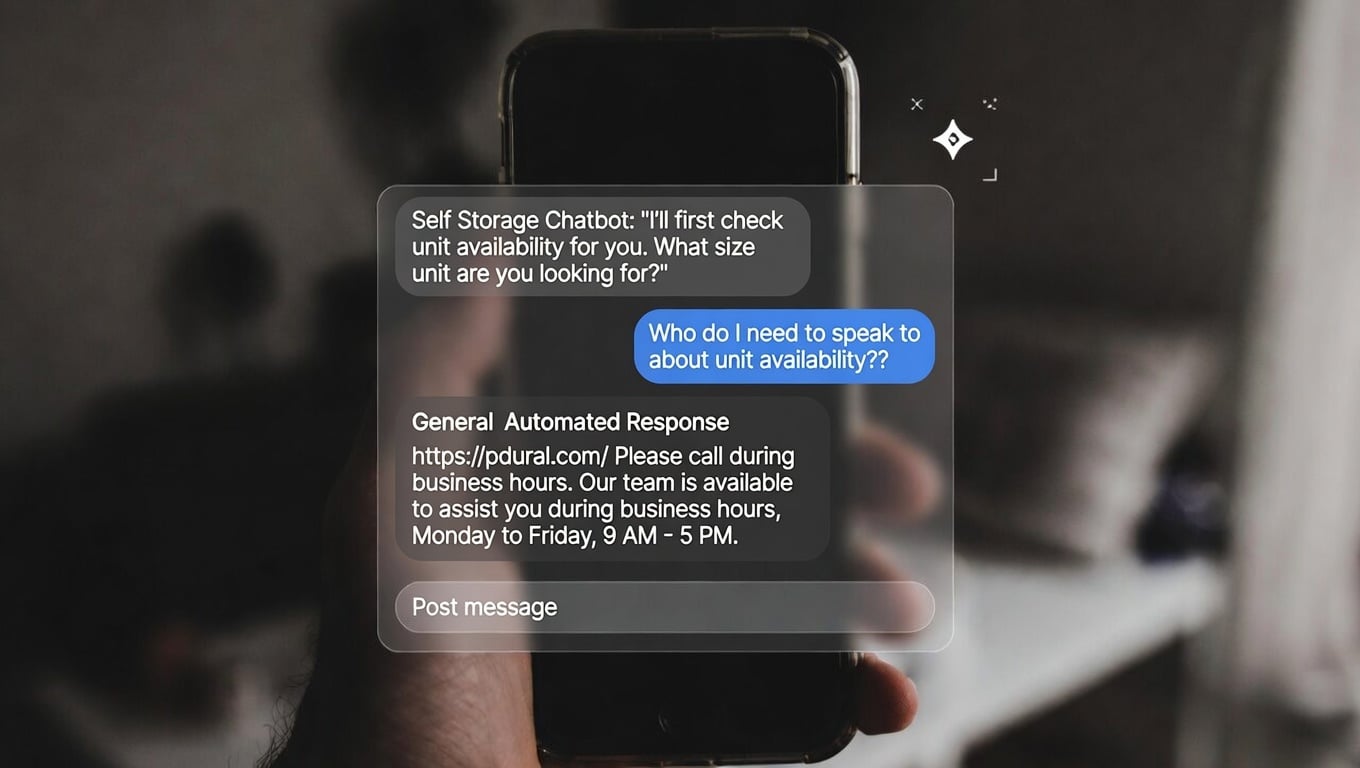
In a typical chatbot interaction, here's what happens: the bot confirms availability. Maybe it shows a price. It suggests the renter call during business hours to reserve, or click through to a rental page to complete the process.
The renter clicks through. The rental page loads. There's a form. There's a lease to review. There are steps. The renter, who was ready to commit thirty seconds ago, is now navigating a checkout flow — and a meaningful percentage of them don't complete it.
The intent was there. The availability was there. The price was right. What wasn't there was a chat experience that could capture the commitment at the moment it existed.
Now consider what a conversion-first chat experience looks like in the same scenario. The renter asks about availability. The chat surfaces live unit options with real-time pricing and value tiers — right inside the conversation. The renter selects a unit. They complete the reservation directly in chat, without a redirect, without a separate form, without breaking the session. The rental is captured. The conversation is over. The renter has a confirmed space.
Same renter. Same intent. Different outcome — because one chat experience was built to answer and one was built to convert.
Why Most Self-Storage Chatbots Stop at the Question
Understanding why most chatbots don't convert requires understanding how they're built and how deeply they connect to the systems that run the operation.
Most self-storage chatbots are built as a layer on top of the website — a widget that connects to a knowledge base or FAQ library, handles common questions through pattern matching or language models, and hands off anything more complex to a human or a contact form. They are, architecturally, a support deflection tool. They reduce the volume of calls and emails about basic questions. That's valuable. But it's not conversion.
The issue isn't that these chatbots have no connection to the operation. Many connect to a property management system in some form. The issue is the depth of that connection — and what the integration is actually built to do.
A shallow integration knows that inventory exists. A deep integration can surface live availability inside the conversation. A shallow integration knows pricing is configured somewhere. A deep integration can present value pricing tiers in real time, inside chat, at the moment the prospect is evaluating options. A shallow integration can acknowledge that reservations are possible. A deep integration can complete one — without a redirect, without a separate form, without breaking the session.
The depth of the integration determines the depth of what chat can do. And in most self-storage chatbot implementations, the integration is built deep enough to answer questions — but not deep enough to take action. The chat knows about the business. It just can't move it forward.
This is the defining difference between a chatbot and a conversion tool. Both may be connected. What separates them is how far that connection actually reaches into the operational systems that allow a conversation to become a rental.
The Full Scope of the Self-Storage Renter Conversation
To understand what conversion-first chat needs to do, it helps to map the full scope of the renter conversation — from first inquiry through move-in and beyond.
The prospect conversation begins with questions: What do you have available? What sizes? What are the features? What does it cost? These are answerable by any chatbot with a reasonable knowledge base. But the prospect conversation doesn't end with answers. It ends with a decision — and a conversion-first chat experience is designed to support that decision all the way to a confirmed reservation.
That means surfacing live availability rather than generic inventory descriptions. It means presenting value pricing tiers inside the conversation so the prospect can compare options without leaving chat. It means enabling the reservation to happen in the same session, without a redirect, without a handoff, without a gap between intent and action.
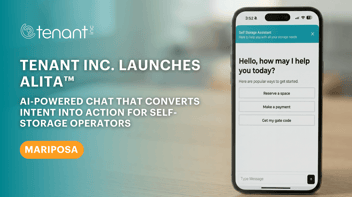
The existing tenant conversation is different in character but equally important. Existing tenants contact facilities regularly for reasons that don't require staff involvement: retrieving a gate code, making a payment, understanding their account status, asking about facility policies. Every one of these interactions that requires a phone call or a portal login is friction — friction that reduces tenant satisfaction and occupies staff time that could be spent on higher-value activity.
A chat experience with deep enough integration to reach tenant account data can handle these interactions inside the conversation. The tenant authenticates, retrieves their gate code, sends a payment link, or gets an answer to a policy question — without the facility being involved at all. The conversation is self-contained. The outcome is immediate.
The policy and procedure conversation is where facility-specific training matters. Generic chatbots answer generic questions. A chat experience trained on a specific facility's hours, access rules, insurance requirements, unit restrictions, and move-out procedures answers the questions that actually come up for that facility's tenants — accurately and consistently, regardless of when the question is asked.

What "Answers That Convert" Actually Means
The phrase "Answers That Convert" is not about closing more sales through aggressive chat scripting. It's about removing the gap between a renter's intent and their ability to act on it.
When a prospect asks if a 10x10 unit is available, the answer they need isn't just "yes." It's "yes, here are your options, here's what they cost, here's how to reserve one right now." When a tenant asks for their gate code at 10pm, the answer they need isn't "please call during business hours." It's the gate code, delivered in the same conversation, after a quick identity verification.
Converting doesn't mean pushing. It means being useful all the way to the outcome — not stopping at the point where the renter has to go somewhere else to finish what they started. And being useful all the way to the outcome requires a chat integration that reaches far enough into the operation to take action, not just describe it.
The practical implications of this are significant:
For occupancy: Every prospect who completes a reservation in chat is a prospect who didn't abandon in a checkout flow. The delta between chat-to-reservation and chat-to-redirect is meaningful — particularly during off-hours when no staff is available to intervene if something goes wrong in the rental flow.
For operations: Every tenant interaction that resolves in chat is a phone call that didn't happen. Every payment collected through a chat-delivered payment link is a delinquency interaction that was resolved without staff involvement. The operational efficiency of conversion-first chat compounds over time as the volume of self-service interactions grows.
For tenant experience: Renters and tenants increasingly expect digital-first interactions that resolve immediately. A chat experience that answers questions but can't take action feels like a dead end — not a service.
The Training Question: Why Generic AI Isn't Enough
One of the most underappreciated requirements for effective AI chat in self-storage is facility-specific training.
A general-purpose AI chat tool can answer general questions. But self-storage operations are not general. They're specific. Your facility has specific hours, specific access rules, specific insurance requirements, specific unit restrictions, specific move-out policies. The answers to the questions your tenants and prospects actually ask are not in a generic knowledge base. They're in the operational details of your specific facility.
A chat experience that answers "do you have drive-up access?" generically — rather than accurately, based on your actual inventory — isn't useful. It's noise. And noise in a chat interaction creates the same outcome as no chat at all: the prospect picks up the phone, or leaves.
Effective AI chat in self-storage requires training on facility-specific data — the policies, procedures, unit characteristics, and operational rules that define how your facility actually works. Without that training, the chat experience gives accurate-sounding answers that may not reflect reality. With it, every response is grounded in the actual details of the facility the prospect or tenant is asking about.
This is not a minor implementation detail. It's the difference between a chat experience that builds trust and one that erodes it.
The Depth Question: How Far Does Your Chat Actually Reach?
Everything described in this post — live availability in conversation, real-time pricing, reservation completion, authenticated tenant self-service, facility-specific training — comes down to one question: how deeply is your AI chat connected to the systems that run your operation?
This is the question worth asking of any AI chat vendor — not "do you integrate with self-storage software?" but "what can you actually do inside that integration?"
A chat solution with surface-level integration can tell a prospect that units are available. One with deep integration can show them which units, at what price, with what features, and let them reserve one in the same conversation. A chat solution with surface-level integration can acknowledge that payments are possible. One with deep integration can send a payment link and collect it inside chat. The difference isn't presence of integration. It's depth.
In a market where most self-storage operators have some form of AI chat, the question is no longer whether the chat window is open. It's whether the chat window is doing anything meaningful when a prospect or tenant engages with it — or whether it's answering questions and sending them somewhere else to finish what they started.
Answers That Convert is not a feature. It's a depth of integration.
.png?width=352&name=A%20Guide%20to%20Evaluating%20AI%20Chat%20for%20Self-Storage%20(1).png)