.png)
"Answers That Convert" is a simple phrase. What it describes is not.
Most self-storage operators who evaluate AI chat are looking at a market full of products that use similar language — intelligent, automated, conversion-focused — without a clear framework for what any of those words mean in practice. The result is a purchasing decision made on demos and feature lists rather than on the operational question that actually matters: will this chat experience capture more rentals, or will it just answer more questions?
This post is a practical guide to that question. It defines what "Answers That Convert" means across the specific interactions that drive self-storage revenue, and it gives operators a framework for evaluating whether a given AI chat solution actually delivers it.
What Conversion Looks Like in Self-Storage Chat
Conversion in self-storage chat is not a single moment. It happens across multiple interaction types, each with its own definition of what a successful outcome looks like.
Prospect inquiry to reservation. A prospect asks about available units. Conversion means the prospect selects a unit and completes a reservation — inside the chat session, without a redirect, without a separate form, without breaking the momentum of the conversation. Anything short of that is a handoff, not a conversion. The prospect has been moved from one channel to another and asked to start over.
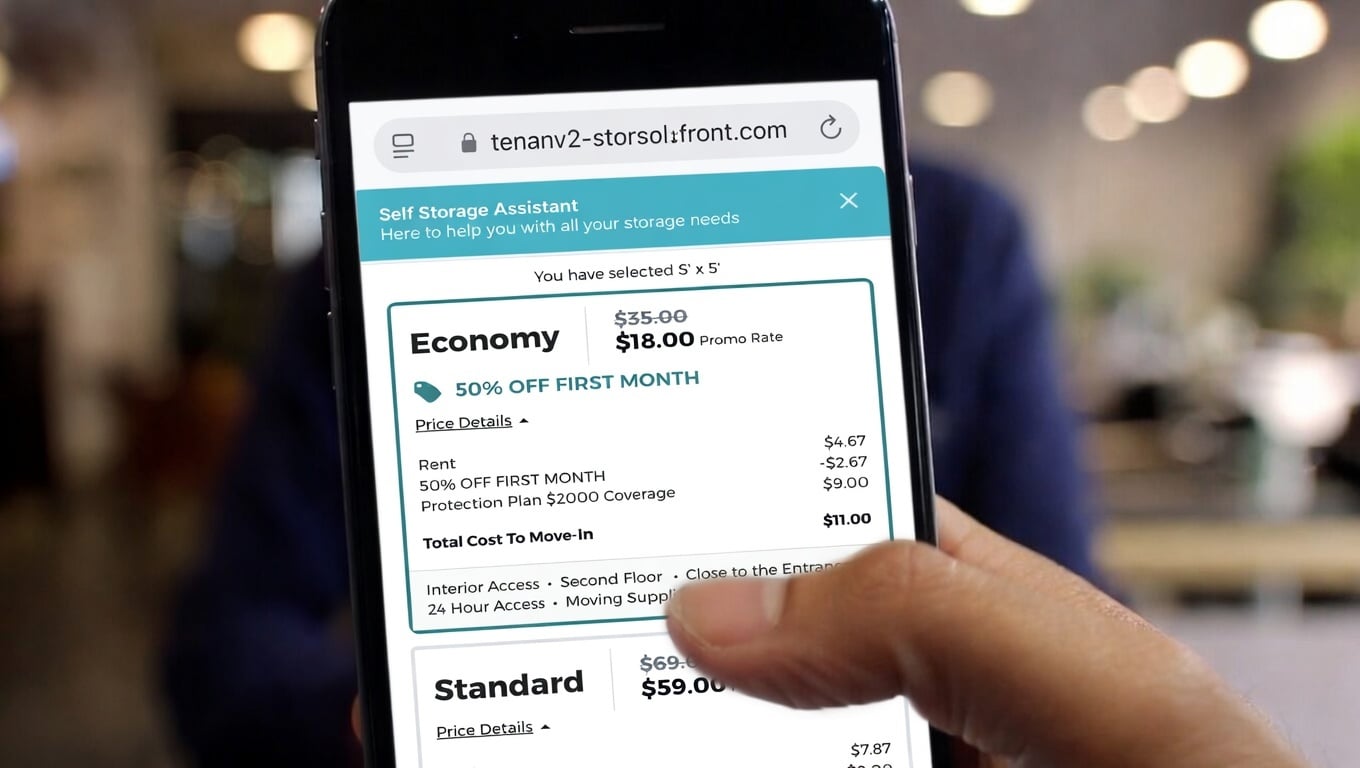
Value presentation to upgrade. A prospect is evaluating unit options. Conversion means the chat presents value pricing tiers — standard, climate-controlled, premium — inside the conversation, at the moment the prospect is deciding. The prospect can compare options, ask questions about the differences, and make a choice without leaving chat. Prospects presented with tiered options in conversation consistently choose higher-value units than those shown a single price and redirected to a website to see the rest. A chat that says "check our website for pricing options" has deflected, not converted.
Tenant inquiry to self-service resolution. An existing tenant needs their gate code at 10pm. Conversion means the tenant authenticates inside chat, retrieves the gate code, and ends the conversation having resolved their need — without calling the office, without logging into a portal, without waiting until business hours. A chat that says "please call us during office hours" has failed the tenant and created a phone call that didn't need to happen.
Payment request to collected payment. A tenant needs to make a payment or is past due. Conversion means the chat delivers a payment link inside the conversation — one the tenant can act on immediately. A chat that confirms a balance but can't collect a payment has informed without converting.
These four interaction types cover the core of what self-storage AI chat needs to do to justify the "converts" in Answers That Convert. They are also the four areas where the depth of a chat solution's integration with the underlying platform determines whether conversion is possible at all.
The Evaluation Framework: Five Questions That Surface the Difference
When evaluating AI chat solutions for self-storage, the following five questions will surface the depth of integration more reliably than any demo or feature comparison.
1. Can the chat complete a reservation — or does it redirect to one?
This is the single most important question. A chat that redirects a prospect to a rental page to complete a reservation has not converted the prospect. It has handed them off to a different conversion flow — one with its own friction, its own drop-off rate, and no guarantee the prospect will complete it.
A chat that completes the reservation inside the conversation — with unit selection, pricing confirmation, and reservation capture all happening in chat — has converted. The distinction is binary. Either the reservation happens in chat or it doesn't.
Ask the vendor to demonstrate a reservation from the prospect's perspective, start to finish, without leaving the chat window. If the demo involves a redirect at any point, the answer is no.
2. Does the chat present value pricing tiers — or a single price?
Most self-storage chatbots can surface availability. The more meaningful question is how they present it.
Value pricing is the good/better/best structure that self-storage operators use to present unit options at different price points based on features, access type, floor level, or amenities. Rather than showing a prospect a single price for a 10x10 unit, value pricing gives them a choice — a standard option, a climate-controlled option, a premium option — at different price points, with the features of each clearly communicated. The conversion benefit is significant: prospects presented with tiered options consistently choose higher-value units at higher rates than prospects presented with a single option.
The question for AI chat is whether that pricing structure is presented inside the conversation — in a way that lets the prospect compare options, ask questions about the differences, and make a choice without leaving chat — or whether the chat surfaces a single price and sends the prospect to the website to see the full range.
A chat that presents value tiers inside the conversation is doing meaningful conversion work at the moment of highest prospect intent. A chat that shows one price and redirects for anything more is leaving the upsell opportunity on the table.
Ask the vendor to demonstrate how value pricing is presented in a prospect conversation. Ask specifically what the prospect sees when they ask about options for a 10x10 unit — one price or multiple tiers with feature differentiation. The answer will tell you whether the chat is built for the way modern self-storage pricing works.
3. Can existing tenants authenticate and self-serve inside chat?
Tenant self-service is the operational efficiency argument for AI chat — and it only materializes if tenants can actually verify their identity and take action inside the conversation.
Gate code retrieval, payment link delivery, and account-related questions all require the chat to authenticate the tenant and access account data. If that authentication requires the tenant to leave chat and log into a portal, the self-service benefit is significantly diminished. Most tenants who need a gate code at 10pm are not going to navigate to a portal login page. They're going to call.
Ask the vendor to demonstrate authenticated tenant self-service — specifically gate code retrieval and payment link delivery — inside a chat session without a redirect.
4. How is the chat trained on facility-specific information?
A chat that answers questions generically is not the same as a chat that answers questions accurately for your specific facility. Your hours, your access rules, your insurance requirements, your unit restrictions, your move-out procedures — these are the details that actually determine whether a prospect's or tenant's question gets a useful answer.
The training question has two parts: how is facility-specific information provided to the system, and how is it updated when things change? If training requires a significant technical implementation every time your policies change, the chat will drift out of accuracy over time. If training is accessible and maintainable by the operator, the chat stays current.
Ask the vendor how you would update the chat if your hours changed, your insurance requirement changed, or you added a new unit type. The answer will tell you how much operational overhead the chat creates over its lifetime.
5. What happens when the chat can't answer?
Every AI chat system has limits. Prospects ask questions outside the training set. Situations arise that require human judgment. The question is not whether the chat has limits — it's what happens when those limits are reached.
A chat that dead-ends — that says some version of "I don't know" and offers no next step — has failed the interaction. A chat that recognizes it can't resolve the conversation and hands off cleanly to a staff member, a contact form, or a scheduled callback has handled it well.
Ask the vendor how unresolved conversations are handled. Ask to see what the handoff experience looks like from the prospect's perspective. A chat that handles its limits gracefully is operationally very different from one that doesn't.
What the Answers Tell You
The five questions above are not a complete evaluation framework for AI chat. There are other considerations — pricing, implementation, support, ongoing training requirements. But they are the questions that surface the depth of the integration, and depth is what determines whether a chat solution converts or just responds.
A solution that can complete a reservation in chat, surface live pricing and availability, authenticate tenants for self-service, train accurately on facility-specific data, and handle its limits gracefully is a conversion tool. A solution that answers questions and redirects for everything else is a support deflection tool.
Both have value. They are not the same product and should not be evaluated as if they are.

The Operator Test
Before any vendor evaluation, it's worth being honest about what you're actually solving for.
If your primary problem is call volume — fielding the same basic questions repeatedly, after hours and during busy periods — a well-trained FAQ chatbot may be sufficient. It will reduce calls. It won't close rentals.
If your primary problem is conversion — capturing prospects who are engaging at off-hours, reducing drop-off between inquiry and reservation, increasing the percentage of chat interactions that result in a signed lease — you need a solution that reaches deeper into your operation.
The difference in what you're solving for should drive the evaluation criteria. "Answers That Convert" is a specific commitment: that chat doesn't just respond, it resolves. That every conversation moves toward an outcome — a reservation, a payment, a self-service resolution — rather than toward another channel.
That commitment requires depth. The five questions above are how you find it.


.png?width=352&name=What%20Is%20Self-Storage%20Revenue%20Management%20(And%20Why%20Static%20Rates%20Are%20Costing%20You).png)